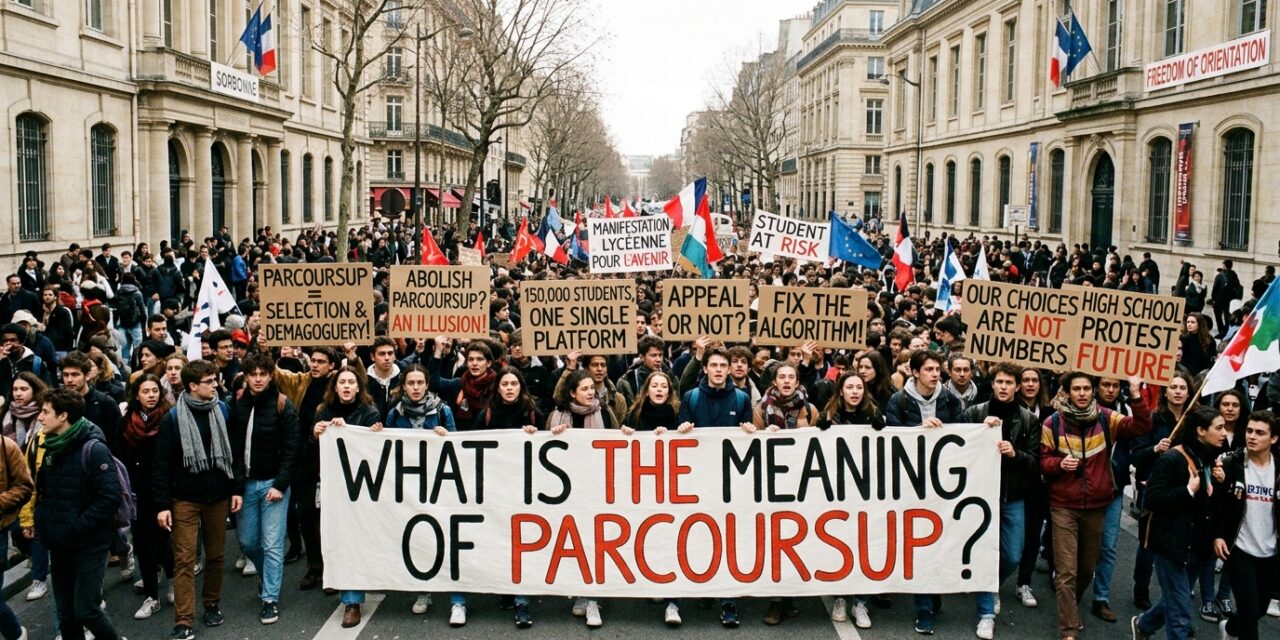
Every spring brings its share of high school protests and blockades. At the heart of the unrest is Parcoursup (the France’s national admissions platform for students entering higher education, which centralize all request for higher education wishes for all French high school students). which has become the ultimate scapegoat for orientation anxieties. Surfing on this discontent, the far-left political spectrum promises the outright abolition of the platform.
Let us be clear: this promise is pure demagoguery.
High school students who believe that a magic wand will abolish the reality of selection and university placement are simply being taken for a ride, lacking both historical perspective and economic judgment.
Let us imagine for a moment the realization of this promise: the firm and definitive repeal of Parcoursup. Once the software is unplugged, what is the alternative? At one point or another, it will inevitably be necessary to match the multiple wishes of around 900,000 candidates with the tens of thousands of courses offered by universities, institutes of technology (IUTs), vocational programs (BTS), and higher education academies.
No one seriously envisions returning to paper application forms, physical queues in front of university halls, or hand-delivering application files—outdated methods that today’s youth have never known. Managing this massive flow will therefore necessarily require a digital tool. On one side, high school students will input their choices, grades, and teacher evaluations. On the other side, higher education institutions will upload their capacity, criteria, and recommended prerequisites. In the middle, a massive algorithm will have to process the whole system to allocate available places among applicants across the country.
This software, whatever name it might be given for political communication purposes, will closely resemble Parcoursup in every shape and form.
It would have been significantly more honest and intellectually rigorous to acknowledge that the platform can indeed be improved, as any software system can. It is certainly not normal, for instance, that fake or automatically generated cover letters can still result in admission, or that minor technical glitches lead to candidates being accepted into programs despite having stated in writing that they did not wish to attend.
These usability and oversight issues deserve to be corrected. However, claiming that the system must be scrapped entirely only to be replaced by another software performing the exact same function is useless, futile, and unnecessarily expensive for public finances.
Furthermore, the argument heavily relied upon by its detractors—asserting that tens of thousands of students end up stranded with no offer from Parcoursup—is factually false.
The figures brandished by opponents include the vast majority of students who chose to pursue tracks outside of Parcoursup (private schools, studies abroad, or non-integrated specialized programs). The overwhelming majority of applicants receive at least one admission offer. Granted, it might not always be their top choice, but an offer is made. The cases of high school students receiving strictly no offer at all by the end of the process are, in reality, virtually non-existent.
In the final analysis, Parcoursup is above all the symptom of a demagogic political approach: a far-left party that exploits high school students’ lack of experience and historical perspective to lure them in with false promises, putting political opportunism ahead of administrative and economic reality.